
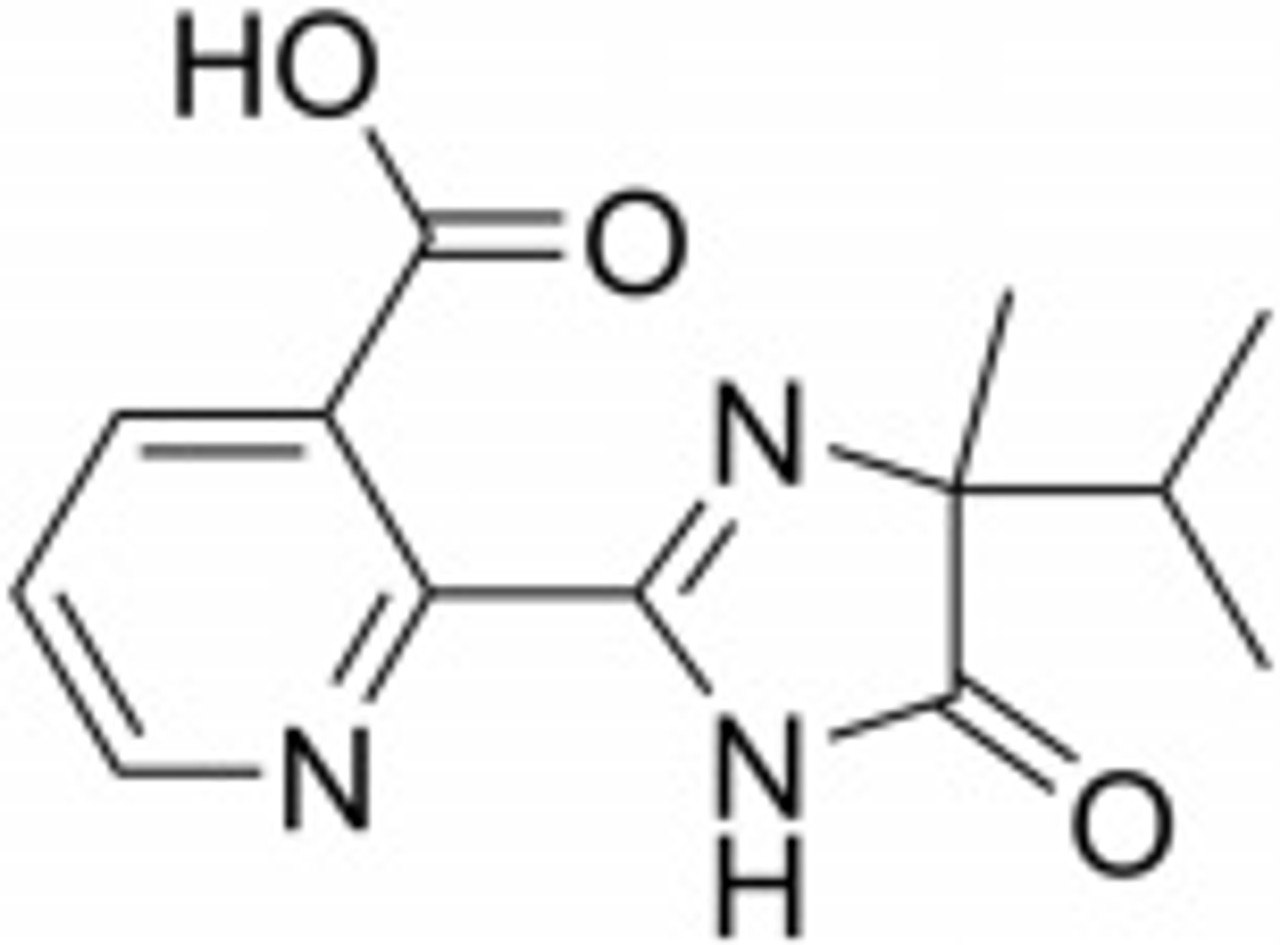
Imazapyr is broad-spectrum herbicide which belongs to the imidazolinone family. It is used for non-cropland applications such as annual and perennial grasses. It can be used as an analytical standard in proteomics.
Imazapyr is highly soluble in water.
| Mechanism of Action | Imazapyr inhibits acetolactate synthase (ALS) which plays an essential role in the biosynthesis of branched chain amino acids, specifically leucine, isoleucine and valine. Upon uptake by foliage and roots, it is rapidly translocated by the plant where it accumulates in the meristem. It disrupts protein synthesis and interferes with DNA synthesis. |
| Spectrum |
Imazapyr is a broad-spectrum herbicide which controls most annual and perennial grasses. It is also active against broadleaved weeds, woody brush, and deciduous trees in non-cropland areas. |
| Plant Biology Applications |
Imazapyr is most effective post-emergence to kill broadleaf weeds and perennial grasses less than 10 cm in height (Armel, 2003). ALS inhibiting herbicides account for approximately 17.5% of the global herbicide usage in corn and other agricultural goods (Green, 2008). It is applied as a foliar spray or pellet for controlling unwanted vegetation. The CSR1 gene from Arabidopsis encodes ALS which catalyzes the first step in branched-chain amino acid biosynthesis. Researchers used a lethal null mutant(csr1-7) created by T-DN insertion into the CSR1 gene and complemented with a randomly inserted 35S/CSR1-2/NOS transgene via transformation. A comparison of this mutant with the transgenic lines found all were resistant to Imazapyr but the transgenic lines yielded higher levels of resistance and greater biomass in the presence of Imazapyr. Microarray analysis revealed a seven to tenfold elevation in CSR1-2 transcript level. Data indicates that transgenesis resulted in similar mutant and transgenic lines, except for the level of herbicide resistance. Transgenesis did not create significant unintended pleiotropic effects on gene expression (Schnell, 2012). |
| Molecular Formula | C13H15N3O3 |
| References |
Armel GR, Wilson HP, Richardson RJ and Hines TE (2003) Use of mixtures of mesotrione, imazethapyr, and imazethapyr plus Imazapyr in imidazolinone-resistant corn (Zea mays). Weed Technol. 17 (4):674-679 Schnell J, Labbé H, Kovinich N, Manabe Y, Miki B (2012) Comparability of imazapyr-resistant Arabidopsis created by transgenesis and mutagenesis. Transgenic Res. 21(6):1255-1264 PMID 22430369 |