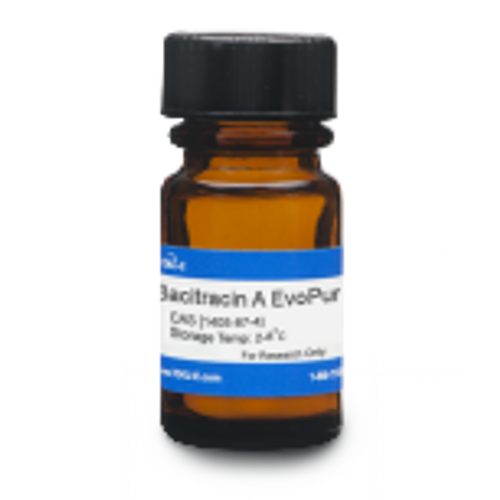


Bacitracin is a branched cyclic dodecylpeptide antibiotic produced by Bacillus licheniformis and some strains of Bacillus subtilis (Azevedo et al 1993). It is synthesized as a mixture of up to 50 closely related congeners/fractions. Bacitracin includes the following fractions: A, B1, B, B2, B3, C, C1, C2, C3, D, E, F, G, H1, H2, H3, I1, I2, I3, and X.
Bacitracin is freely soluble in aqueous solution.
Bacitracin is a polypeptide antibiotic, a mixture composed of related cyclic peptides made by Bacillus licheniformis first isolated in 1945 from the 'Tracy I' variety (ATCC 10716). It was isolated by Balbina Johnson, a bacteriologist at Columbia University. Bacitracin can be synthesized via nonribosomal peptide synthetases (NRPSs). The three-enzyme operon is called BacABC.
For more Bacitracin products, click here.
| Mechanism of Action | Bacitracin prevents phosphorylation of bactoprenol, a transport protein which carries peptidoglycan components outside the cell membrane. Without the active phosphorylated bactoprenol, peptidoglycan synthesis cannot be completed and the cell lyses. Resistance to Bacitracin is understood to involve two mechanisms: A protein transporter (BcrABC) which pumps Bacitracin out of the cell after it has entered, and via another protein (BacA) which provides the active phosphorylated bactoprenol from a different synthetic pathway. |
| Spectrum | Bacitracin inhibits cell wall synthesis in Gram-positive bacteria including Streptococcus pyogenes and Staphylococcus aureus. Representative MIC values include:
|
| Impurity Profile | Composition Content of Bacitracin A: ≥ 40.0% Content of active Bacitracin: ≥ 70.0% of total area Limit of early eluting peptides: ≤ 20.0% Limit of Bacitracin F: ≤ 6.0% |
| Microbiology Applications | Bacitracin is a useful tool to differentiate between ß-hemolytic, group A Streptococci (Streptococcus pyogenes) and ß-hemolytic Streptocococci of other groups. Bacitracin can be used as a supplement in chocolate agar to facilitate the isolation of Haemophilus influenzae. Bacitracin can be used to study the regulatory network in B. subtilis. By systematically analyzing the Bacitracin stimulon, authors can pinpoint the loci induced by Bacitracin (Mascher et al 2003). |
| Plant Biology Applications | Tobacco hairy roots and cell suspensions were used in plant transformation studies to produce full length murine IgG1 monoclonal antibodies. Bacitracin has been shown to prevent degradation of peptides and hormones in plant systems. Treatment with Bacitracin was not sufficient to prevent loss of antibody from the cultures, but improved the growth rates by up to 53% (Sharp and Doran, 1999). |
| Cancer Applications |
Bacitracin, a pan-inhibitor of the protein disulfate isomerase (PDI) family, prevented lipopolysaccharide-induced monocyte TF production under inflammatory conditions and showed promising anticoagulant activity. Inhibition of PDI may thus be a promising approach in the management of AML-associated coagulation disorders. Learn more on our blog. |
| Molecular Formula | C66H103N17O16S |
| Source | Bacillus subtilis and B. licheniformis |
| References |
Beckmann L et al (2021) Bacitracin and Rutin regulate Tissue Factor production in inflammatory monocytes and Acute Myeloid Leukemia blasts. Cancers. 13(16):3941 Bell, RG (1992) Preparative high-performance liquid chromatographic separation and isolation of Bacitracin components and their relationship to microbiological activity. J. Chromatog. 590:163-68 |
| MIC | Bacteroides fragilis| >8|| Clostridium difficile| >256|| Clostridium perfringens| 0.25|| Clostridium spiroforme| 4 - >8|| Diplococcus pneumoniae| 0.04 - 12.5|| Enterococcus faecium| ≤1120 - ?|| Escherichia coli| >8 - 1560|| Fusarium oxysporum| 55|| Fusobacterium necrophorum| 9.4 - 100|| Haemophilus influenzae| >16 - 400|| Listeria innocua| 50|| Listeria monocytogenes (FBUNT)| 32|| Listeria spp.| ≤8 - >128|| Moraxella catarrhalis| 1 - 4|| Neisseria gonorrhoeae| 800|| Penicilium oxallicum | 50|| Propionibacterium freudenreichii | <1|| Proteus vulgaris| 700|| Pseudomonas aeruginosa| 700|| Salmonella Agona (14749 + serovar B)| 3120|| Salmonella Anatum (12453 + serovar E)| 3120|| Salmonella Brandenburg (15865 + serovar B)| 3120|| Salmonella Cerro| 1560|| Salmonella Choleraesuis (12630 + serovar C1)| 3120|| Salmonella Dublin| 1560 - 3120|| Salmonella Give| 3120|| Salmonella Muenster| 3120|| Salmonella Newport (12418 + serovar C2)| 3120|| Salmonella Ohio (14497 + serovar C1)| 3120|| Salmonella Stanley (17031 + serovar E)| 3120|| Salmonella typhimurium| ≤1120 - 3120|| Staphylococcus aureus| ≤0.03 - 700|| Staphylococcus auricularis| 0.25 - 128|| Staphylococcus capitis| 0.25 - >128|| Staphylococcus caprae| 16|| Staphylococcus cohnii| >128|| Staphylococcus epidermidis| 0.25 - >16|| Staphylococcus haemolyticus| 0.25 - >128|| Staphylococcus hominis| 0.25 - 16|| Staphylococcus intermedius | 0.25 - 128|| Staphylococcus lugdunensis| 0.25 - >4|| Staphylococcus pyogenes (erythromycin-resistant)| 0.25 - >4|| Staphylococcus saprophyticus| 0.25 - >128|| Staphylococcus sciuri| 16|| Staphylococcus simulans| 0.25 - 128|| Staphylococcus warneri | 0.25 - >128|| Staphylococcus xylosus (LQC 5156)| >128|| Streptococci (Viridans group)| 2 - >16|| Streptococcus agalactiae| 2 - >16|| Streptococcus faecium| 850|| Streptococcus pneumonia| 0.06 - >16|| Streptococcus pyogenes| 0.5 - >16|| Treponema hyodysenteriae | 12.5 - 50|| |