
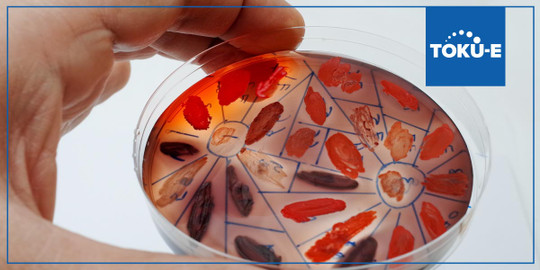
What is a biofilm?
A biofilm is a population of microorganisms in a self-created extracellular matrix. Most bacteria in nature exist in a biofilm, such as in seawater, groundwater, soil, and ocean sediments. Several pathogenic bacteria like Clostridium difficile, Escherichia coli, Staphylococcus aureus and Pseudomonas aeruginosa) and pathogenic fungi such as Candida albicans can produce biofilms in humans.
The hallmark of biofilm formation is the matrix which is composed of polysaccharides, proteins, lipids, DNA and RNA. It functions as a reservoir, holding a mixture of active biomolecules. Enzymes in this matrix break down complex sugars into polysaccharides that can be used as a nutrient source, and changes to the matrix structure can change the biofilm properties altogether (Liu et al, 2024).
The biofilm lifecycle has five steps: initial attachment, irreversible attachment of cells, micro-colony formation, biofilm maturation and dispersion.
Being in a biofilm offer several advantages for these microbes They become more resilient to environmental stresses like low oxygen, fluctuations in temperature, antimicrobials, and even the host's own immune system (Davies, 2013).
Significance of biofilms
Common biofilm-related medical conditions such as gingivitis, acute ear infection, and persisting urinary tract infection. More severe concerns include biofilm-forming P. aeruginosa infections, the leading cause of death in cystic fibrosis patients.
For those with implanted medical device implants such as catheters, prosthetic joints, and pacemakers, biofilm-forming infections are concerning since these microbes are protected from antimicrobials and the host immune system.
Biofilm structure and development can vary based on the bacterial species and strain, and on the surrounding environmental conditions.
How do biofilms lead to antimicrobial resistance?
The extracellular matrix can physically restrict the diffusion of antibiotics, but it does not account for the whole process of antimicrobial resistance (AMR). Microbes in the biofilm can secrete degradative enzymes that can inactivate or destroy antibiotics (Lewis et al, 2015). Nutrients and oxygen are also prevented from reaching too deep into a biofilm. This creates a starvation-induced state in some cells called "persister cells" which are metabolically inactive cells that have been shown (in vitro) to contribute to AMR [Davies, 2013).
Most antibiotics target enzymes that are active in cellular growth and division. Persister cells generally are not sensitive to these antibiotics because the targeted enzymes are essentially inactive. Persister cells are of great concern as they may be able to revert back to a normal state and restore the biofilm. The polymyxin antibiotic Colistin can act as a cationic detergent and bind to the negatively charged lipopolysaccharide present in the outer membrane of P. aeruginosa and has no such requirement for metabolic activity thus it could be useful for cystic fibrosis biofilms (Martin et al, 2021). When in combination with other antimicrobials, Colistin can demonstrate superior efficacy. Colistin-tobramycin can eradicate P. aeruginosa biofilms in vitro. Colistin-ceftolozane/tazobactam and Colistin/meropenem combinations showed reduced bacterial counts of biofilm-embedded P. aeruginosa. Colistin-aminoglycoside combinations could eradicate persister cells of P. aeruginosa.
Cells in a biofilm are held together closely which is conducive to horizontal gene transfer. Thus, biofilms can act as reservoirs for resistance genes. Multispecies biofilms and the impacts of various interactions, including cooperation and competition, between bacterial species on tolerance to antimicrobials is a topic for further research (Liu et al, 2024).
How can we combat resistant biofilms?
Some examples of anti-biofilm strategies include:
1) Stop the biofilm before it forms. Researchers found that Honokiol and magnolol can restrict biofilm formation in vitro (Sun et al, 2015).
2) Target the extracellular matrix. Authors removed the extracellular DNA of an Aspergillus fumigatus strain with DNAase and found that it later became susceptible to the antifungal compounds Amphotericin B and Caspofungin (Rajendran et al, 2013).
3) Prevent biofilm-related cellular communication (quorum sensing). Quorum sensing is the regulation of gene expression in response to changes in the density of a bacterial community. By preventing this communication the biofilm can become weaker and less organized (Jabra-Rizk et al, 2006). Azithromycin can disrupt quorum sensing in a mouse infection model. Furthermore, the antibiotics Ciprofloxacin and Ceftazidime have also been shown to disrupt quorum sensing (Martin et al, 2021).
4) Use competition between microbes. Researchers found Candida albicans's biofilm development was affected by the presence of Pseudomonas aeruginosa which inhibited the establishment of C. albicans filamentation (Hogan et al, 2004).
5) Disperse the biofilms. Authors exposed S. aureus biofilms to fibrinolytic agents that effectively dispersed the biofilm and dispersed cells could be killed if antimicrobials were added in combination also. Authors exploited this process to treat staphylococcal biofilm device-related infections under biomimetic conditions where S. aureus biofilms exposed to fibrinolytic agents were effectively dispersed when coupled with antimicrobials (Hogan et al, 2018).
Biofilms are just one of the ways that microorganisms shield themselves from antimicrobials. Future research incorporating models of mixed community biofilms to better understand antimicrobial resistance in this environment is a fascinating topic to be explored.
References
Davies D (2003) Understanding biofilm resistance to antibacterial agents. Nature Reviews Drug Disc, 2(2), 114-122 Link
Gibbons JG et al (2011). Global Transcriptome Changes Underlying Colony Growth in the Opportunistic Human Pathogen Aspergillus fumigatus. Euk. Cell, 11(1), 68-78 Link.
Hogan DA, Vik Å and Kolter R (2004). A Pseudomonas aeruginosa quorum-sensing molecule influences Candida albicans morphology. Molec. Microbiol. 54(5), 1212-1223. Link.
Hengzhuang W el al (2013) High β-lactamase levels change the pharmacodynamics of β-lactam antibiotics in Pseudomonas aeruginosa biofilms. Antimicrob Agents Chemother. 2013 Jan;57(1):196-204 Link.
Hogan S, O’Gara JP and O’Neill E (2018) Novel treatment of Staphylococcus aureus device-related infections using fibrinolytic agents. Antimicrob. Agents Chemother. 62 (2018). Link.
Jabra-Rizk et al (2006) Effect of Farnesol on Staphylococcus aureus Biofilm Formation and Antimicrobial Susceptibility. Antimicrob. Agents and Chemother. 50(4), 1463-1469. Link.
Lewis K (2001) Riddle of biofilm resistance. Antimicrob. Agents and Chemother. 45(4):999-1007 Link.
Liu HY, Prentice EL and Webber MA (2024) Mechanisms of antimicrobial resistance in biofilms. Antimicrob Resist 2:27 (2024). Link.
Martin I, Waters V and Grasemann H (2021). Approaches to targeting bacterial biofilms in cystic fibrosis airways. Int. J. Molec. Sci 22(4):2155 Link.
Molin S and Tolker-Nielsen T (2003) Gene transfer occurs with enhanced efficiency in biofilms and induces enhanced stabilisation of the biofilm structure. Curr. Opin. Biotechnol. 14(3):255-261 Link.
Rajendran R et al (2013). Extracellular DNA Release Acts as an Antifungal Resistance Mechanism in Mature Aspergillus fumigatus Biofilms. Euk. Cell, 12(3), 420-429 Link.
Sun L, Liao K and Wang D (2015). Effects of Magnolol and Honokiol on Adhesion, Yeast-Hyphal Transition, and Formation of Biofilm by Candida albicans. PLoS ONE, 10(2). Link.
Sun F et al (2013). Biofilm-associated infections: Antibiotic resistance and novel therapeutic strategies. Future Microbiol 8(7), 877-886 Link.