
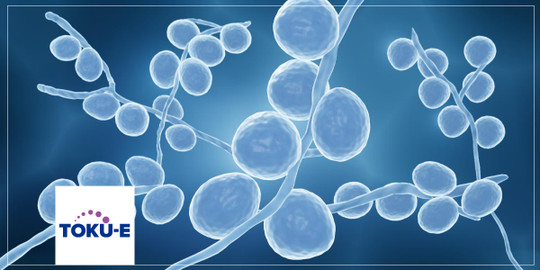
Antifungals are compounds that inhibit the growth of fungi (called ‘fungistatic’) or kill fungi (called ‘fungicidal’). Fungi include yeasts, rusts, smuts, mildews, molds and mushrooms.
In microbiology, antimycotics can be used in selective media to inhibit the growth of fungi in environmental or food samples to help isolate the bacterial pathogen of study. Antimycotics can also be used in susceptibility testing to determine how effective an antimycotic is. Antifungal resistance is a grave concern driven by many extrinsic factors like extensive use of fungicides, overuse, environmental changes, and host factors. Antifungals can also be used to study resistance patterns. In cell or plant tissue culture, antifungal agents are used in contamination control.
Some categories of antifungals include:
Polyenes: These compounds bind to ergosterols in the fungal cell membrane. This changes the transition temperature of the membrane, so the membranes becomes more crystalline. The result is that the fungal cell contents leak, and the fungal cell dies.
Examples include Amphotericin B, Candicidin, and Nystatin.
Amphotericin B (syn: Fungizone) is effective against fungi and yeast infections. Our R&D team can optimize our antifungals to improve certain qualities. A great example is our Amphotericin B, Solubilized, Lyophilized which is an improved format with enhanced water solubility, stability and improved shelf life. We also offer a convenient Amphotericin B ReadyMade™ Solution and Nystatin ReadyMade™ solution.
Azoles: These compounds inhibit the conversion of lanosterol to ergosterol via inhibition of the enzyme lanosterol 14 alpha-demethylase. These compounds all have a five-membered ring. They are broken into 2 subclasses: Imidazoles (containing two nitrogen atoms) or Triazoles (containing three nitrogen atoms).
Examples of imidazoles include Clotrimazole, Ketoconazole, and Luliconazole.
Examples of triazoles include Voriconazole, Fluconazole, and Isavuconazole.
Echinocandins: These compounds act by inhibiting 1,3-beta-glucan synthase, which inhibits 1,3-beta-glucan production, an important component of the fungal cell wall. This leads to a disruption of the cell wall integrity, leading to death of the fungal cell. This is especially useful for Candida or Aspergillus infections.
Examples include Anidulafungin, Caspofungin, Micafungin, and Rezafungin.
One particular study sourced seven antifungals from TOKU-E to study simulated blood cultures for the reliability of recovery of antifungal agents in candidemia samples caused by Candida. This study was done at the Università Cattolica del Sacro Cuore in Rome, Italy and incorporated the following: Amphotericin B, Anidulafungin, Caspofungin, Fluconazole, Micafungin, Posaconazole and Voriconazole (Posteraro et al, 2023).
It is important to eliminate and prevent fungal infections before they start since they can impact plant cell health and experimental reproducibility. In fact, antifungal agents are important additives to culture medium when culturing cell lines or conducting plant tissue culture.
We have a variety of antifungal agents to choose from for contamination control and susceptibility testing purposes and we invite you to explore our wide selection today.
Reference
Posteraro B et al( 2023) Efficient recovery of Candida auris and five other medically important Candida species from blood cultures containing clinically relevant concentrations of antifungal agents. Microbiol Spectr 11:e04104-22 Link.