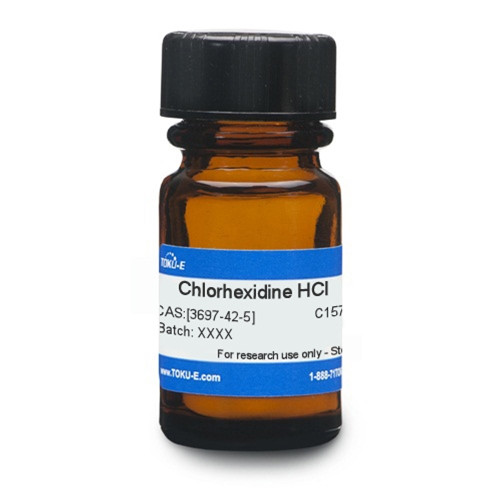


Chlorhexidine is an antibacterial agent commonly used as a disinfection agent and has broad-spectrum activity. It has bactericidal and bacteriostatic effects. Chlorhexidine is used in dental research and is a common additive in the prevention of dental plaque.
This product is considered a dangerous good. Quantities above 1 g may be subject to additional shipping fees. Please contact us for questions.
We also offer:
- Chlorhexidine Diacetate (C200)
| Mechanism of Action |
Chlorhexidine is a cationic molecule which interacts with and alters the negatively charged bacterial cell wall. This interaction leads to leakage of cellular components at low concentrations and cellular lysis at higher concentrations. At physiologic pH, chlorhexidine salts dissociate and releases the positively charged chlorhexidine cation. This cationic molecule binds to the negatively charged bacterial cell wall. At low chlorhexidine concentration, this leads to a bacteriostatic effect but at high concentrations this membrane disruption results in cell death. |
| Spectrum | Chlorhexidine has a broad spectrum of activity and is active against Gram-positive and Gram-negative bacteria, yeasts, and some viruses. |
| Molecular Formula | C22H30Cl2N10 |
| References |
Jones CG (1997) Chlorhexidine: Is it still the gold standard. Periodontology 15:55-62 Moshrefi A. Chlorhexidine. J West Soc Periodontol Periodontal Abstr. 2002;50(1):5-9. PMID: 12049062. |