
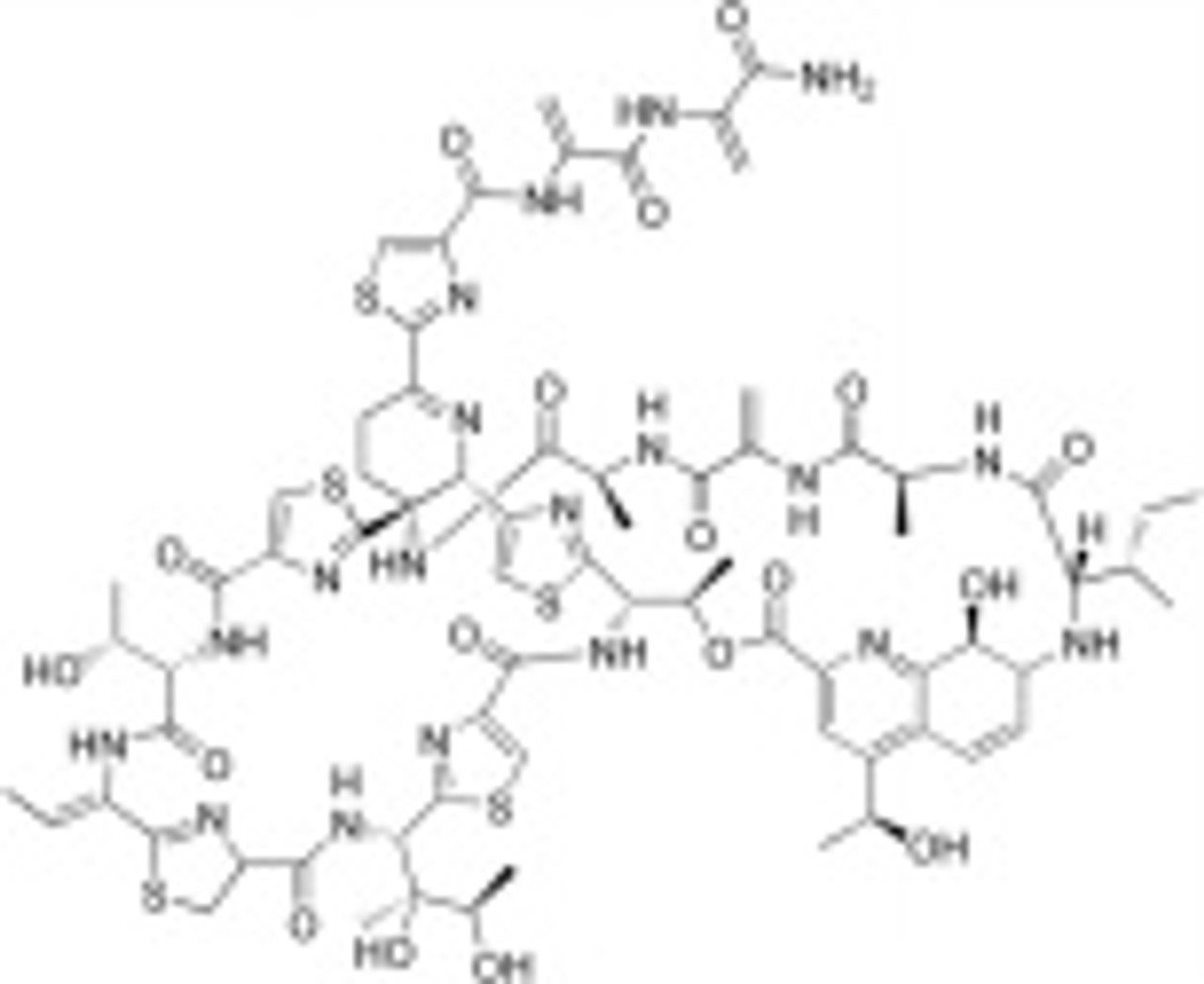
Thiostrepton, USP is a bactericidal macrocyclic thiopeptide antibiotic that is produced by Streptomyces azureus and was originally detailed by Donovick et al. in 1955. Thiostrepton shows broad activity against both Gram-positive and Gram-negative bacteria, as well as anti-plasmodial effects.
Thiostrepton inhibits prokaryotic translation by inhibiting ribosome turnover after the elongation step in protein synthesis by inhibiting both the dissociation of elongation factor G (EF-G) from the ribosome and the release of inorganic phosphate from EF-G following GTP hydrolysis. Thiostrepton has also been shown to inhibit the binding of elongation factor 4 (EF4) to the 70S ribosome.
Thiostrepton has been shown to inhibit the oncogenic transcription factor FoxM1 and is cytotoxic to malignant mesothelioma cells in a dose dependent fashion.
Thiostrepton conforms to United States Pharmacopoeia specifications.
| Mechanism of Action | Thiostrepton inhibits prokaryotic translation by inhibiting ribosome turnover after the elongation step in protein synthesis by inhibiting both the dissociation of elongation factor G (EF-G) from the ribosome and the release of inorganic phosphate from EF-G following GTP hydrolysis. Thiostrepton has also been shown to inhibit the binding of elongation factor 4 (EF4) to the 70S ribosome. |
| Spectrum | Thiostrepton is a broad-spectrum antibiotic which targets a wide range of Gram-positive and Gram-negative bacteria. Thiostrepton has also shown antimalarial and gametocytocidal activity. |
| Microbiology Applications |
The Thiostrepton resistance gene (tsr) and its mutants can serve as effective selectable markers for the genetic modification of bacterial thermophiles, like Geobacillus Kaustophilus, and other bacteria. |
| Cancer Applications |
Thiostrepton is an inhibitor of Forkhead box M1 (FoxM1), a transcription factor that has been shown to play an important role in the development and progression of human cancers. FoxM1 inhibited by Thiostrepton induced apoptosis in nasopharyngeal carcinoma cells (NPC) by down regulation of bcl-2, and the up-regulation of bax and p53, while also inducing the release of cytochrome c accompanied by activation of caspase-9, cleaved caspase-3 and cleaved PARP. Thiostrepton has been shown to be an effective anti-cancer stem cell agent in vitro, thiostrepton could selectively induce apoptosis in colorectal stem cells (CRSC) subpopulations in both parent HCT-15 and HT-29 human CRC lines as well as EMT and chemoresistant clones derived from them. Thiostrepton in combination with oxaliplatin was shown to eradicate CR44+ HCT-15 and HT-29 cells more effectively than either compound alone. |
| Molecular Formula |
C72H85N19O18S5 |
| References |
Aminake MN et al (2011) Thiostrepton and derivatives exhibit antimalarial and gametocytocidal activity by dually targeting parasite proteasome and apicoplast. Antimicrob. Agents. Chemother. 55(4), 1338-1348 Ju S, Huang C, Huang W and Su Y (2015) Identification of Thiostrepton as a novel therapeutic agent that targets human colon cancer stem cells. Cell Death & Dis. 6(7) e1801 Keisuke Wada K et al (2016) A Thiostrepton resistance gene and its mutants serve as selectable markers in Geobacillus kaustophilus HTA426, BioSci. Biotechnol. and Biochem. 80(2):368-375 Kwok JM et al (2008) Thiostrepton selectively targets breast cancer cells through inhibition of Forkhead box M1 expression. Mol Cancer Ther. 7(7):2022-2032 PMID 18645012 Walter JD, Hunter M, Cobb M, Traeger G, Spiegel PC (2012) Thiostrepton inhibits stable 70S ribosome binding and ribosome-dependent GTPase activation of elongation factor G and elongation factor 4. Nucleic Acids Res. 40(1):360-370 PMID 21908407 |
| MIC | Bacillus subtilis| 0.02 - 0.04|| Streptococcus pneumonia| ≤0.06|| |