
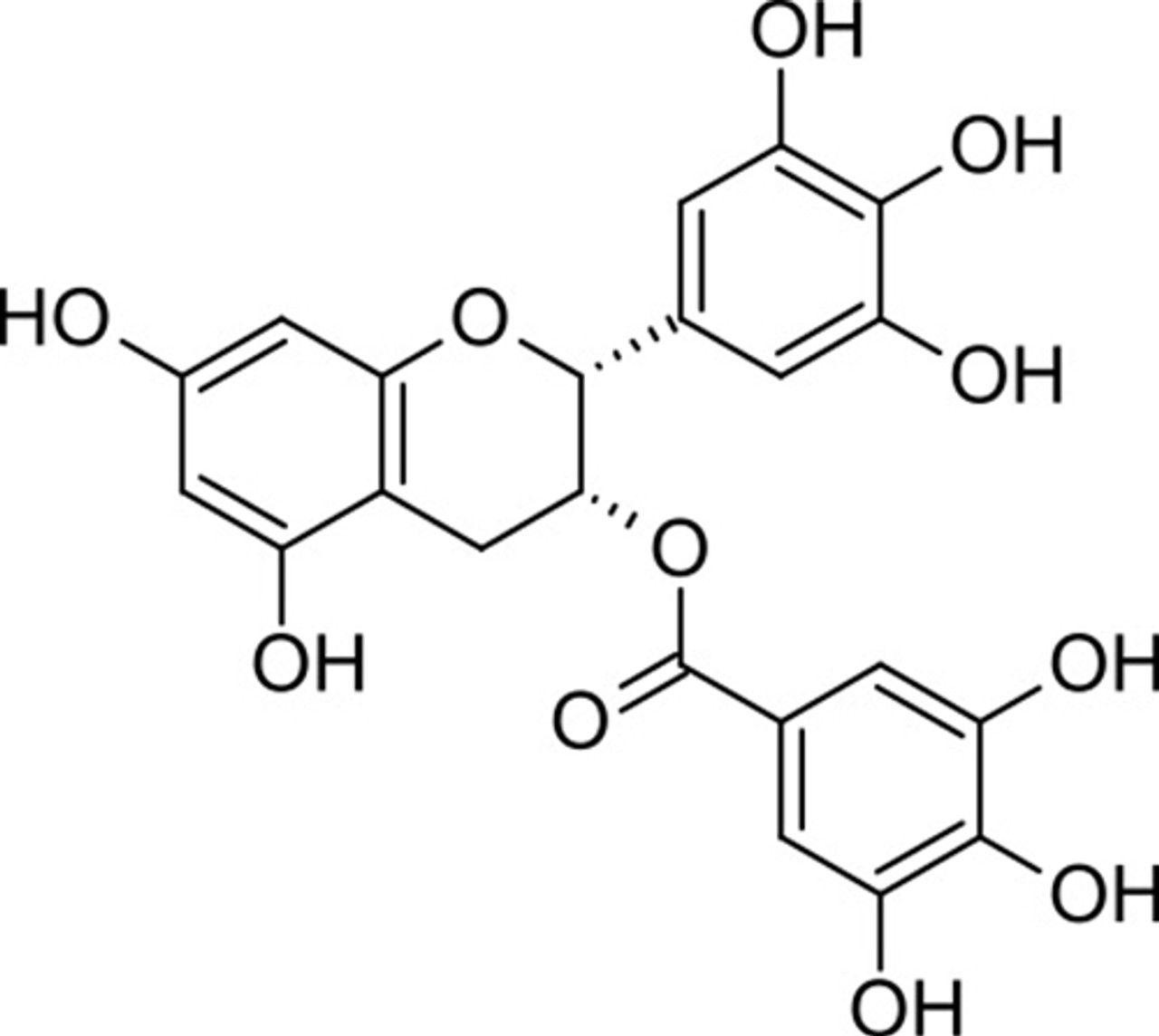
Epigallocatechin Gallate (syn: EGCG), the catechin found in green tea (Camellia sinensis). The main bioactive constituents of green tea leaves are catechins, which account for 25% to 35% of their dry weight. EGCG has three aromatic rings (A, B and D) that are linked together by a pyran ring (C). EGCG is the ester of epigallocatechin and gallic acid. The compound is an antioxidant polyphenol belonging to the flavonoid family. It has been reported to have an exhaustive list of promising bioactivities. EGCG has antiparasitic activity against Leishmania, antiviral activity against influenza A and hepatitis B viruses, and antifungal activity against Candida albicans. EGCG has anti-inflammatory effects and can induce apoptosis selectively to transformed cells and has potential anticancer activity.
| Spectrum |
EGCG has broad-spectrum activity against Gram-negative and Gram-positive bacteria including methicillin-resistant Staphylococcus aureus. Activity on diverse families of viruses including Retroviridae, Orthomyxoviridae and Flaviviridae and along with human immunodeficiency virus (HIV), influenza A virus and hepatitis C virus. EGCG interferes with the replication cycle of DNA viruses like hepatitis B virus, herpes simplex virus and adenovirus. |
| Mechanism of Action |
EGCG exerts anti-tumor properties by inhibiting telomerase and DNA methyltransferase activity. It inhibits the expression of matrix metalloproteinase-2 (MMP-2), MMP-9 and reduces its invasiveness. It blocks the activation of epidermal growth factor (EGF) receptors and human epidermal growth factor receptor-2 (HER-2). EGCG inhibits osteoclastogenesis by inhibiting receptor activator of nuclear factor κ-B ligand (RANKL) induced nuclear factor κ B (NF-κB) transcriptional activity. EGCG has anti-aging property and increases myogenic differentiation. EGCG inhibits fatty acid synthase and glutamate dehydrogenase activity as well. EGCG interacts with plasma membrane proteins and phospholipids which stimulate intracellular signaling pathways (Singh et al, 2011). |
| Microbiology Applications |
Pseudomonas aeruginosa exhibiting multidrug resistance were tested with EGCG and green tea extract (GTE). EGCG inhibited the growth of P. aeruginosa at a MIC level of 200~400 µg/ml. The MIC of GTE was a 1:16 dilution. In addition, they tested E. coli strains also showing multidrug resistance. EGCG had antimicrobial activity against E. coli at a MIC of 400 µg/ml. For green tea extract (GTE), the MIC was 1:8 - 1:4 dilution (Gordon and Wareham, 2010). EGCG enhances the antifungal effect of amphotericin B or fluconazole against antimycotic-susceptible and -resistant C. albicans (Hirasawa and Takada, 2004). |
| Eukaryotic Cell Culture Applications |
When HepG2 cells were incubated with the primary green tea constituents (catechins), EGCG was the only catechin to increase LDL receptor binding activity (3-fold) and protein (2.5-fold) above the controls. At 200 uM, it increased cellular cholesterol efflux (Bursill and Roach, 2006). |
| Cancer Applications |
EGCG anti-cancer activities are due to its control of cell signaling pathways. It inhibits heregulin-β1-induced activation of ErbB2 and ErbB3, as well as migration and invasion of MCF-7 breast cancer cells indicating that it can inhibit metastasis of some cancer cell lines (Kushima et al (2009). EGCG has anti-cancer actions and anti-cancer stem cell effects, and impacts various molecular targets for its cancer inhibition (Gan et al, 2017). EGCG interferes with numerous signaling pathways and biological mechanisms related to cancer development and progression. EGCG is a potential compound for cancer therapy due to its anti-proliferative properties, pro-differentiation properties and apoptosis-inducing properties (Bartosikova and Necas, 2018). EGCG has anti-tumor effects on a number of carcinomas and human cancer cell lines Khan et al 2006). |
| References |
Bartosikova L and Necas J (2028) Epigallocatechin gallate: A review. Vet Med-Czech 63(10):443-467 Bursill CA and Roach PD (2006) Modulation of cholesterol metabolism by the green tea polyphenol (−)-epigallocatechin gallate in cultured human liver (HepG2) cells. J. Agric. Food Chem. 54, 1621-1626 PMID 16506810 Gan R, Li H, Sui Z, Corke H (2017) Absorption, metabolism, anti-cancer effect and molecular targets of epigallocatechin gallate (EGCG): An updated review. Crit. Rev. Food Sci. Nutr. 58(6):924–941 Gordon NC and Wareham DW (2010) Antimicrobial activity of the green tea polyphenol (−)-epigallocatechin-3-gallate (EGCG) against clinical isolates of Stenotrophomonas maltophilia. Int. J. Antimicrob. Agents 36(2):129-131 PMID 25324647 Hirasawa M and Takada K (2004). Multiple effects of green tea catechin on the antifungal activity of antimycotics against Candida albicans. J. Antimicrob. Chemother. 53(2):225-229 PMID 14688042 Inacio JD, Gervazoni L, Canto-Cavalheiro MM and Almeida-Amaral EE (2014). The Effect of (-)-Epigallocatechin 3-O - Gallate in vitro and in vivo in Leishmania braziliensis: Involvement of reactive oxygen species as a mechanism of action. PLoS Negl. Trop. Dis. 8(8) Khan N, Afaq F, Saleem M, Ahmad N, Mukhtar H. Targeting multiple signaling pathways by green tea polyphenol (-)-epigallocatechin-3-gallate. Cancer Res. 2006 Mar 1;66(5):2500-5. doi: 10.1158/0008-5472.CAN-05-3636. PMID: 16510563 Kushima Y et al (2009) Inhibitory effect of (‒)-epigallocatechin and (−)-epigallocatechin gallate against heregulin β1-induced migration/invasion of the MCF-7 breast carcinoma cell line. Biol. Pharm. Bull. 32(5):899-904 Steinmann J, Buer J, Pietschmann T and Steinmann E (2013). Anti-infective properties of epigallocatechin-3-gallate (EGCG), a component of green tea. Br. J. Pharmacol. 168(5):1059-1073 PMID 23072320 Wang YC and Bachrach U (2002) The specific anti-cancer activity of green tea (−)-epigallocatechin-3-gallate (EGCG). Amino Acids 22(2):131-143 Zhong Y, Chiou Y, Pan M and Shahidi F (2012) Anti-inflammatory activity of lipophilic epigallocatechin gallate (EGCG) derivatives in LPS-stimulated murine macrophages. Food Chem. 134(2):742-748 |