

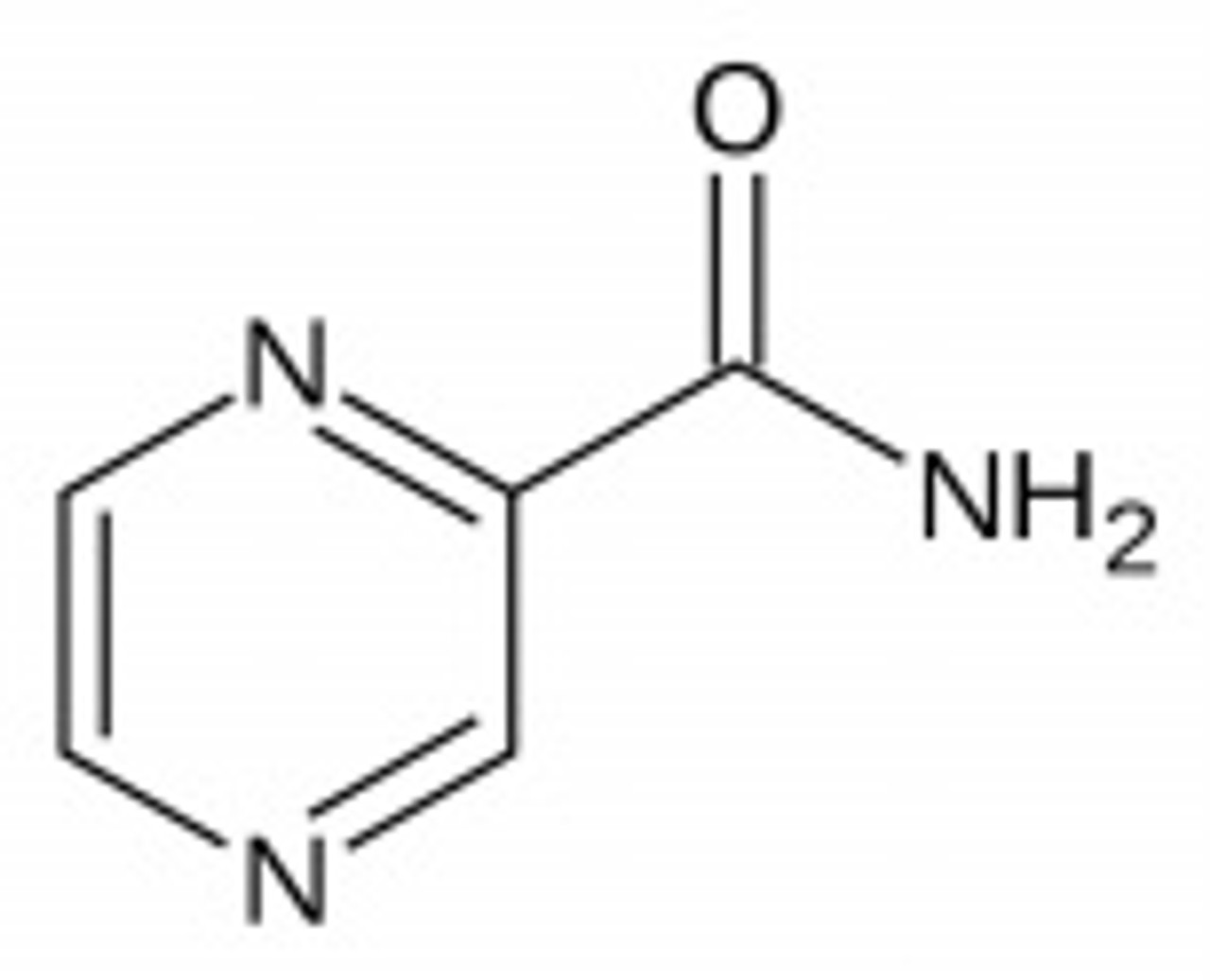
Pyrazinamide is a sparingly soluble bactericidal antitubercular drug. It is often used in combination with Rifampicin, Isoniazid, and either Streptomycin or ethambutol. It was first discovered and patented in 1936, but not used against tuberculosis until 1952. Its discovery as an antitubercular agent was surprising since it has no activity against tuberculosis in vitro since it is not active at neutral pH thus would not be expected to work in vivo. However, Nicotinamide was known to have antitubercular activity and it was thought to behave similarly. Researchers at Lederle and Merck confirmed its activity in mice and it was used in subsequent human studies. It kills non-replicating persisters that other tuberculosis compounds fail to kill, and thus making it essential for inclusion in any compound combinations against drug-susceptible and drug-resistant TB such as MDR-TB. Resistance is mostly caused by mutations in the pncA gene encoding pyrazinamidase involved in conversion of the prodrug Pyrazinamide to the active form POA.
We also offer:
| Mechanism of Action | The mechanism of pyrazinamide is not entirely understood. It is speculated that pyrazinamide (the prodrug) enters a target cell and is converted into its active form pyrazinoic acid (POA) by nicotinamidase/pyrazinamidase (PZase) which is encoded by the pncA gene in M. tuberculosis and POA which disrupts normal membrane permeability functions. Internal pH of the cell begins to decrease as POA accumulates in the cell’s cytoplasm which is thought to inhibit fatty acid synthase activity. |
| Microbiology Applications |
However, PZA is exactly the opposite to common antibiotics as it has no or little activity against growing tubercle bacilli and is primarily active against non-growing persisters (Zhang et al, 2013). Recent studies have shown that PZA enters M. tuberculosis via passive diffusion, is converted to POA then excreted by a weak efflux pump. |
| Spectrum | Pyrazinamide is used almost exclusively against Mycobacterium tuberculosis. |
| Solubility | Alcohol: Slightly soluble Methylene Chloride: Slightly soluble Water: Sparingly soluble |
| Impurity Profile | Heavy Metals: ≤10ppm Chloride: ≤140ppm Sulphated Ash: ≤0.01% |
| References |
Cynamon MH et al (1995) Activity of N-propyl pyrazinoate against Pyrazinamide-resistant Mycobacterium tuberculosis: Investigations into mechanism of action of and mechanism of resistance to Pyrazinamide. Antimicrob. Agents Chemother. 39(6):1269-1271 Scorpio A and Zhang Y (1996) Mutations in pncA, a gene encoding pyrazinamidase/nicotinamidase, cause resistance to the antituberculous drug Pyrazinamide in tubercle bacillus. Nat Med. 2(6):662-667 PMID 8640557 Zhang Y and Mitchison D (2003) The curious characteristics of Pyrazinamide: A review. Int. J. Tuberc. Lung Dis. 7(1):6-21 PMID 12701830 Zhang Y, Shi W, Zhang W, Mitchison D (2013) Mechanisms of Pyrazinamide action and resistance. Microbiol Spectr. 2(4):1-12 PMID 25530919 |