
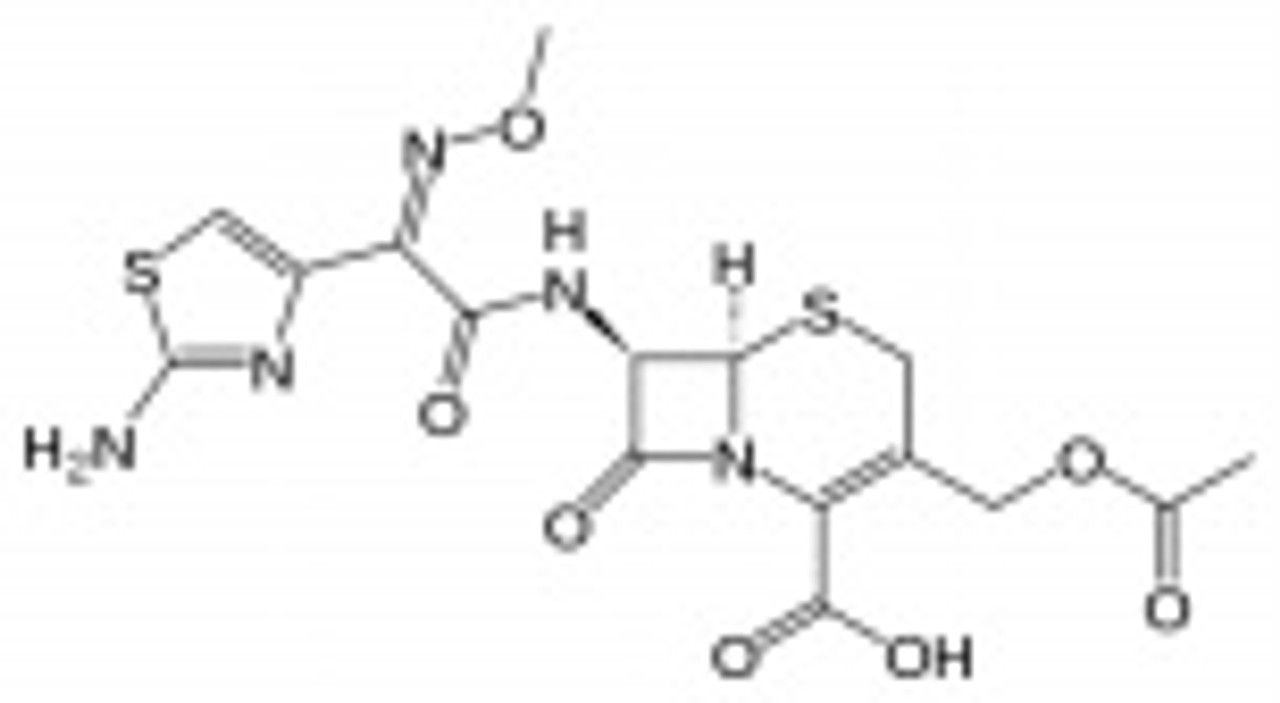
Cefotaxime Sodium, USP is broad-spectrum, third-generation cephalosporin. It interferes with bacterial peptidoglycan synthesis. Cefotaxime Sodium is freely soluble in aqueous solution.
Cefotaxime was discovered in 1976 and came into commercial use in 1980.
Cefotaxime Sodium, USP conforms to United States Pharmacopoeia specifications.
We also offer:
- Cefotaxime ReadyMadeTM Solution (C293)
| Mechanism of Action | Like β-lactams, cephalosporins interfere with PBP (penicillin binding protein) activity involved in the final phase of peptidoglycan synthesis. PBP’s are enzymes which catalyze a pentaglycine crosslink between alanine and lysine residues providing additional strength to the cell wall. Without a pentaglycine crosslink, the integrity of the cell wall is severely compromised and ultimately leads to cell lysis and death. Resistance to cephalosporins is commonly due to cells containing plasmid encoded β-lactamases. Cefotaxime Sodium however, is largely resistant to β-lactamases. |
| Spectrum | Cefotaxime Sodium has broad-spectrum activity against a wide variety of Gram-positive and Gram-negative bacteria. However, unlike many cephalosporin antibiotics, Cefotaxime Sodium does not have activity against Pseudomonas aeruginosa. |
| Microbiology Applications | Cefotaxime Sodium is commonly used in clinical in vitro microbiological antimicrobial susceptibility tests (panels, discs, and MIC strips) against Gram-positive and Gram-negative microbial isolates. Medical microbiologists use AST results to recommend antibiotic treatment options. Representative MIC values include:
|
| Plant Biology Applications |
Cefotaxime is often used in Agrobacterium tumefaciens mediated transformation to combat bacterial growth. It is also sometimes used in combination with vancomycin as it has a synergistic effect. Cefotaxime Sodium was used Agrobacterium-mediated transformation of cucumber with strain Agrobacterium GV3101. Marker gene neomycin phosphotransferase II (npt II). Cefotaxime Sodium was suitable for inhibiting Agrobacterium in the screening and bud elongation stage (2022). |
| Molecular Formula | C16H16N5NaO7S2 |
| Impurities | Chromatographic Purity: Single Impurity: ≤1.0% Total Impurities: ≤3.0% |
| References |
Georgopapadakou NH (1992) Mechanisms of action of cephalosporin 3'-quinolone esters, carbamates, and tertiary amines in Escherichia coli. Antimicrob. Agents. Chemother. 37(3): 559-65 PMID 8384817 Mathias RJ and Boyd LA (1986) Cefotaxime stimulates callus growth, embryogenesis and regeneration in hexaploid bread wheat (Triticum aestivum L. em Thell). Plant Sci. 46:217-223 Du C, Cha L and Liu C et al (2022) Improved Agrobacterium tumefaciens-mediated transformation using antibiotics and acetosyringone selection in cucumber. Plant Biotechnol Rep. 16:17–27 Ferrer-González E, Kaul M, Parhi AK, LaVoie EJ and Pilch DS (2017) Lactam antibiotics with a high affinity for PBP2 act synergistically with the FtsZ-targeting agent TXA707 against methicillin-resistant Staphylococcus aureus. Antimicrob. Agents Chemother. 61(9):e00863-17 PMID 28630190
|