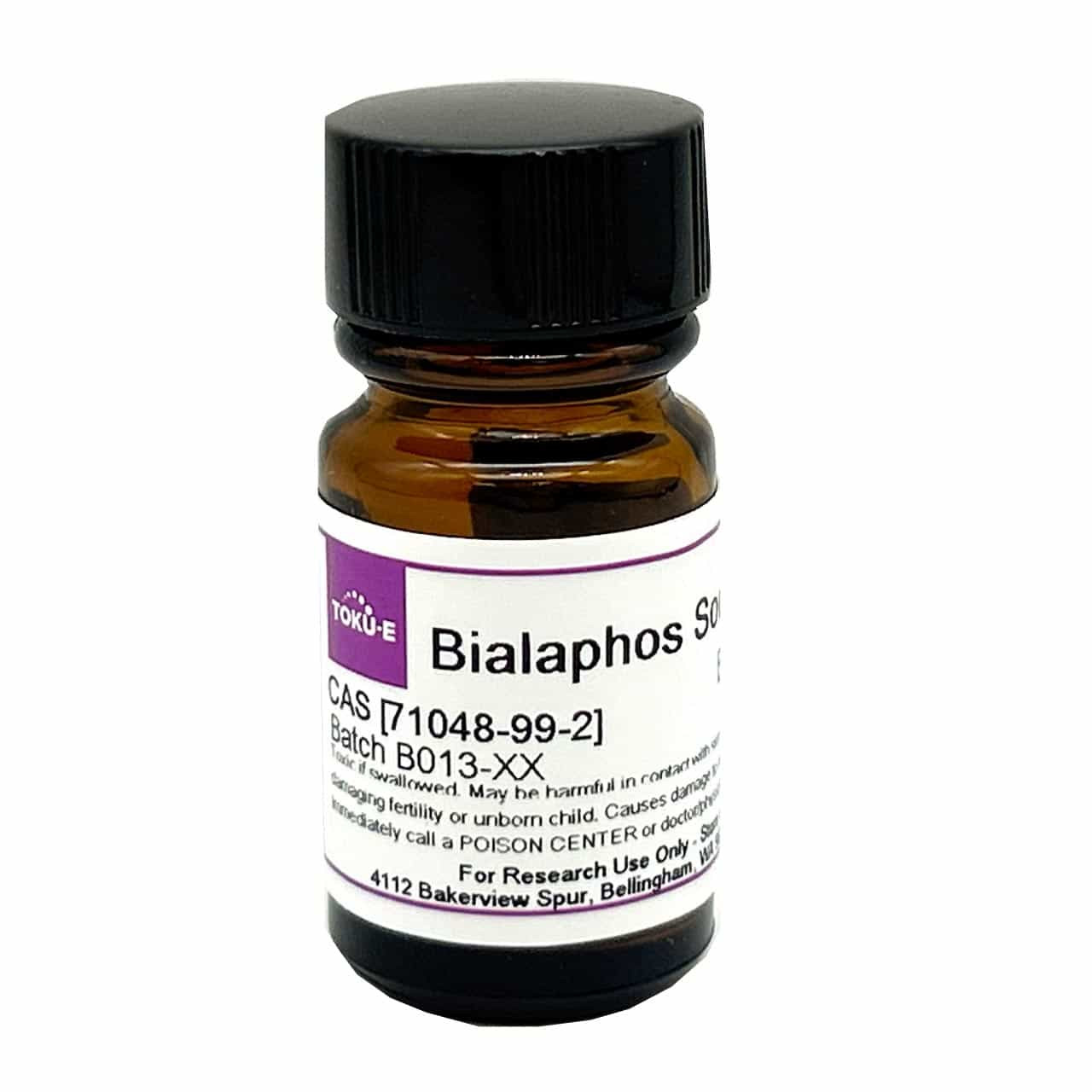

Bialaphos Sodium is a tripeptide antibiotic synthesized by Streptomyces hygroscopicus. This proherbide is commonly used for gene selection in cereals, and is a bar gene selective agent.
Bialaphos Sodium is freely soluble in water.
This product is considered a dangerous good. Quantities above 1 g may be subject to additional shipping fees. Please contact us for questions.
We also offer:
- Bialaphos ReadyMadeTM Solution (B100)
| Mechanism of Action | Bialaphos acts as a proherbicide by separating into individual subunits of alanylalanine and phosphinothricin. Phosphinothricin is toxic to cells by triggering the accumulation of ammonia, and inhibiting photosynthesis and glutamine synthesis. |
| Microbiology Applications |
Bialaphos Sodium (TOKU-E) was used to study its effects on oligopeptide transporters in a Sinorhizobium meliloti hfq mutant (Sobrero et al, 2011). Streptomyces hygroscopicus (and S. viridochromogenes) can both convert intermediates from primary metabolism into Bialaphos, a tripeptide with a unique structure not identified anywhere else in nature (Thompson and Seto, 1995). |
| Plant Biology Applications | Bialaphos Sodium is used in transformation of cereals including wheat, rice, maize, barley, sorghum, oat and rye. The bar gene is incorporated in the plant genome along with the gene of interest. When Bialaphos is applied, only plants which are successfully transformed survive (Aragão, 2002). |
| Molecular Formula | C11H21N3NaO6P |
| References |
Aragão FJL and Brasileiro ACM (2001) Positive, negative and marker-free strategies for transgenic plant selection. Braz. J. Plant Physiol. 14(1):1-10 Thompson CJ and Seto H (1995) Bialaphos. Ch. 6 in: Vining LC and Stuttard C (eds.) Genetics and Biochemistry of Antibiotic Production, Butterworth-Heinemann. pp.197-222 |